

 LinkedIn
A client asks for four variations of a buyer question. Your AEO tool calls them four more billable prompts. That gap between ordinary client work and a vendor’s definition of usage is where agency margin goes.
The median agency bills $6,850 a month for an answer engine optimization retainer, up 66% since early 2024. It looks like healthy margin until you try to deliver across twenty accounts using software that meters prompts, domains, seats and scans separately.
Agencies comparing white-label AEO software aren’t stuck on features. They’re stuck on vocabulary. White label, continuous tracking and edge proxy can mean very different things on a pricing page and in a live client account. Here are the 17 terms I would pin down before signing.
White-label execution
Definition: Client-facing reports, optimization work and strategic plans are delivered under an agency’s brand, without vendor attribution.
Practitioner gloss: A client logo on a dashboard and a new button colour are cosmetic branding. They do not get a technical fix published or a content update made. Agency operators discussing white-label SEO delivery make the practical complaint: diagnostic dashboards still leave account managers doing the work.
For me, the test is whether the platform executes or merely recommends. An agency needs to own the client relationship, but it should not have to turn every software suggestion into another manual task. Our white-label AI SEO glossary goes deeper on that distinction.
Flat-rate multi-domain pricing
Definition: One predictable software fee covers deployment across multiple client domains without per-site add-on charges.
Practitioner gloss: Some tiers call themselves multi-domain because they include three sites, then charge $99 a month for each additional URL. That is a domain allowance, not flat-rate multi-domain pricing. Ask what happens to the bill when your roster passes ten accounts, not just whether the tier technically supports ten.
The useful number is cost per client as you grow. A predictable fee lets a new retainer improve gross margin instead of triggering another vendor negotiation. That is the economic question behind groas for agencies: execution scales across unlimited ad accounts, with search visibility priced per domain transparently rather than disguised as a vague “multi-domain” promise.
Percentage-of-retainer markup
Definition: The vendor takes a share of an agency’s client retainer instead of charging for the software it supplies.
Practitioner gloss: I disliked percentage-of-spend fees in paid search because the management bill rose when the media budget rose, whether or not the work did. A percentage-of-retainer software fee carries the same problem into AEO: selling a larger engagement increases your vendor bill.
At the $6,850 median monthly AEO retainer, a 15% platform cut takes more than $1,000 per account. The software runs the same work whether the client pays you $2,000 or $10,000. Do not confuse a vendor’s claim on your sales with a cost of execution.
Per-seat user tax
Definition: Each team member, contractor or client who needs a login adds a monthly software charge.
Practitioner gloss: A normal delivery pod may include an account manager, technical specialist, copy editor and operations lead. At $49 to $99 per seat, letting the people responsible for the work see the account can add hundreds of dollars before anyone changes a page.
The practical question is not whether you can share a login. It is whether ordinary collaboration changes your unit economics. If the account manager has to ration access to protect margin, the tier was not designed around agency delivery.
Tracked prompt cap
Definition: The number of distinct search queries a monitoring tool will check across generative interfaces during a billing cycle.
Practitioner gloss: A “prompt” may be counted separately for each engine, location or variation. Semrush’s AI Visibility Toolkit is described at $99 a month for 25 tracked prompts, an effective $3.96 per prompt at that limit; Profound Starter is listed at $1.98 per prompt for ChatGPT alone.
Eight buyer questions across three engines use 24 tracking units for one client. Repeat that for fifteen clients and a 300-prompt pool is already too small. Count the questions your clients will actually ask, then multiply by engines and accounts. Otherwise reporting becomes a monthly argument about which questions deserve a slot. I wrote more about that trap in selling AEO by the prompt.
Multi-engine credit multiplier
Definition: One tracked query consumes different numbers of credits depending on the engine and how often the tool scans it.
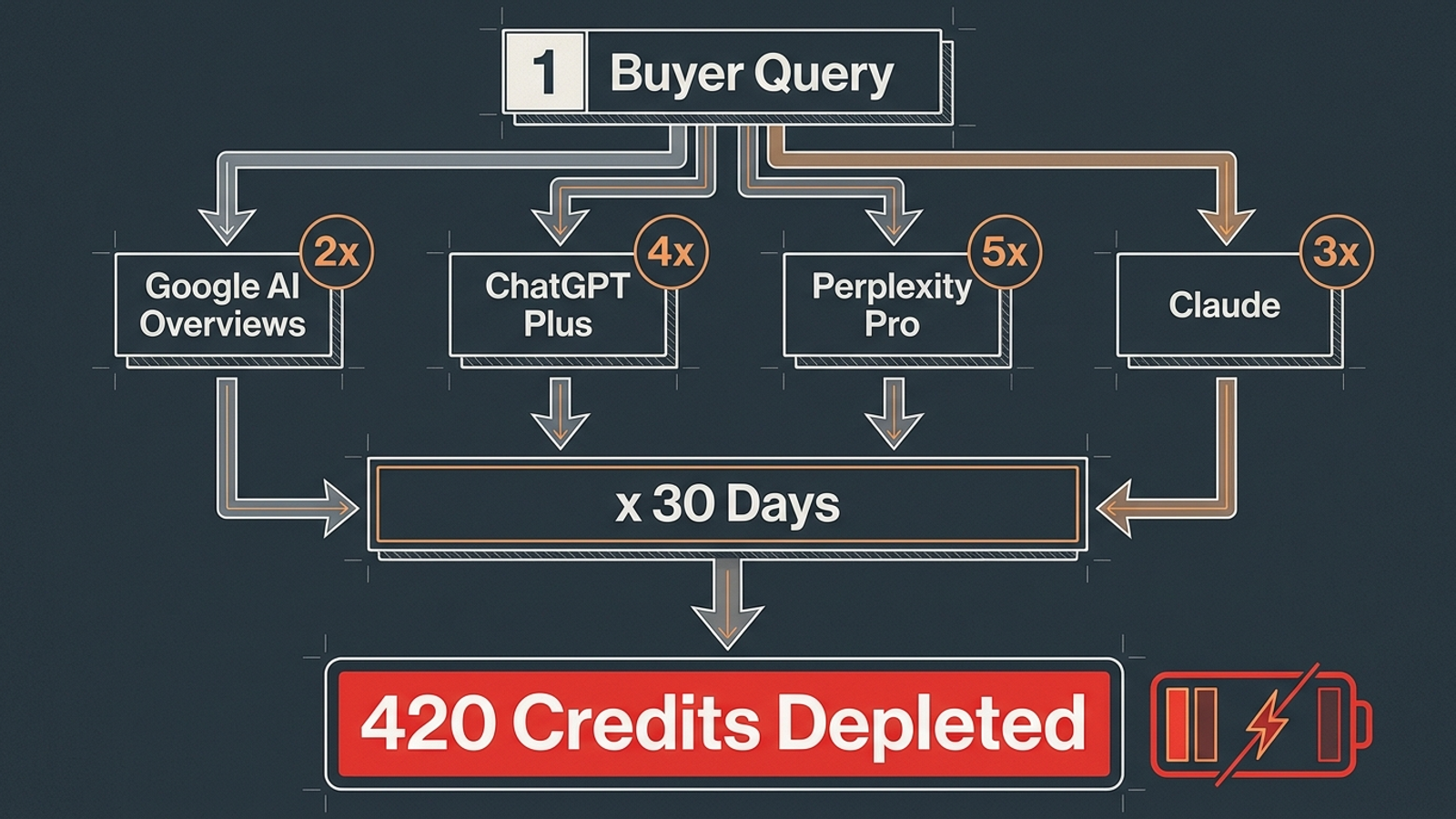
Practitioner gloss: “10,000 monthly credits” sounds generous until you see the consumption table. In the example pricing matrix, a Google AI Overviews scan costs 2 credits, ChatGPT Plus 4 and Perplexity Pro 5. A daily cadence multiplies each by 30; one buyer query checked across four engines can consume 420 credits in a month.
Pricing guides put credit-based AEO software at $0.13 to $1.98 per unit and entry-tier tracking at $0.86 to $3.96 per prompt per month once multi-engine scans are included. Those ranges are less useful than your own planned workload. Translate credits into one client’s monthly report before buying the tier. If that requires a spreadsheet, make the vendor fill it in with you.
Edge proxy architecture
Definition: A cloud routing layer intercepts web requests and changes page HTML before serving it to search engines and AI crawlers.
Practitioner gloss: The attraction is obvious when a client’s CMS is locked down: change routing rules rather than wait for a development queue to add structured data or answer blocks. The risk sits in the same place. A conflict with the origin cache or a failed SSL certificate renewal at the edge can affect client traffic, not just a dashboard metric.
An edge proxy is part of the delivery path, not a harmless reporting add-on. Test routing rules before a roster-wide rollout. That is why I would test edge AEO on three clients before rolling it to fifteen.
Serverless render quota
Definition: The monthly limit on pages an edge or dynamic-rendering layer serves to bots before overage charges or a fallback takes effect.
Practitioner gloss: Site count does not tell you render capacity. Encited lists 50 sites and 500,000 serverless renders on its $349-a-month Agency plan. Put a client with a 15,000-SKU catalogue behind an edge layer and crawler activity can consume that allowance far faster than the site count suggests.
If the quota runs out, the consequence depends on the implementation: overage charges or pages falling back to unrendered source code. Either matters to the client. Ask what happens on render 500,001, who gets alerted and which pages bots receive after the limit is reached. A site allowance without that answer is half a price.
Direct-to-CMS automated publishing
Definition: Software pushes markup, content updates and answer blocks into a client website through CMS APIs.
Practitioner gloss: This is where a recommendation tool either becomes an execution engine or hands the job back to your staff. “Rewrite this H2” is not a delivered change. Neither is an FAQ schema suggestion sitting in a queue while someone copies text between thirty WordPress and Shopify admin panels.
Direct publishing should work within predetermined guardrails so strategists can decide what matters without doing the mechanical entry themselves. Ask what gets published, what needs approval and what remains a task for your team. That answer is more valuable than another list of generated recommendations.
Answer mapping
Definition: Answer mapping identifies the claims and summaries an AI system draws from source pages when constructing an answer.
Practitioner gloss: It sounds like proprietary natural-language processing. Sometimes the deliverable is little more than extracted page text and a generic summary. If a vendor charges a per-domain setup fee, look at the output: does it isolate the numerical figures, pricing bands, technical compatibilities and schema attributes that matter to a buyer’s question?
Done by hand, that work can consume dozens of strategist hours per client. An autonomous context engine can keep the map current as retrieval changes. Pay for a maintained map of useful facts, not an impressive name for a one-time summary.
Citation building
Definition: Citation building seeks branded references and contextual mentions on external sites that generative search engines may use as sources.
Practitioner gloss: This term gives old directory submissions a new jacket. A vendor can take low-tier guest posts and local listings, call the package a Generative Engine Authority Network, and charge for “AI citations” without showing where useful references appear.
A $1,500 monthly pack of boilerplate directory blurbs is not the same as relevant editorial coverage or mentions on trusted industry sites. Inspect the placements before you buy the label. If the pages would not help a human understand or verify the client’s business, calling them AEO does not improve them.

Knowledge graph entity management
Definition: Entity management aligns a brand’s sites and profiles with recognised entries in Wikidata, Google’s Knowledge Graph and related repositories.
Practitioner gloss: This can matter, especially for a corporate portfolio with subsidiaries and overlapping product lines. But an ongoing $2,000-to-$4,000 monthly “entity management” fee deserves scrutiny if the work is a SameAs schema block, a link to an existing company profile and a Wikidata edit.
Separate the initial structural work from ongoing maintenance. Once identifiers and schema are established, ask what the vendor will change each month. If there is no clear answer, the recurring fee may be paying for the same setup work repeatedly.
llms.txt generation and maintenance
Definition: llms.txt is a proposed plain-text Markdown file at a website’s root that offers context and URLs to language agents.
Practitioner gloss: Vendors and agencies charge $500 to $1,500 for initial generation and up to $4,500 on recurring retainers to create and maintain this file. Yet Google Search and Google AI Overviews do not use llms.txt for ranking, retrieval or citations, and the draft’s cited study of 137,000 sites found that 97% of these files received no crawler visits.
I would not sell a static text file as a substitute for making useful site content accessible. Ask which crawler uses it and what the monthly fee changes. A file that takes twenty minutes to write should not quietly become a four-figure recurring deliverable.
Share of voice in AI search
Definition: Share of voice is the percentage of a defined set of commercial queries on which a brand appears in generative answers relative to competitors.
Practitioner gloss: The phrase sounds sturdier than the sample behind it. Run ten prompt variations, find the client in three answers and a competitor in six, and a dashboard can print “30% AI Share of Voice.” Run the prompts again with a different context, profile or location and the sources may change.
The metric can help you watch a defined set of questions. It cannot promise a fixed lift across every answer a buyer might see. Before accepting a chart or a guarantee, ask which prompts, engines and scan conditions produced it.
Citation rate vs. mention rate
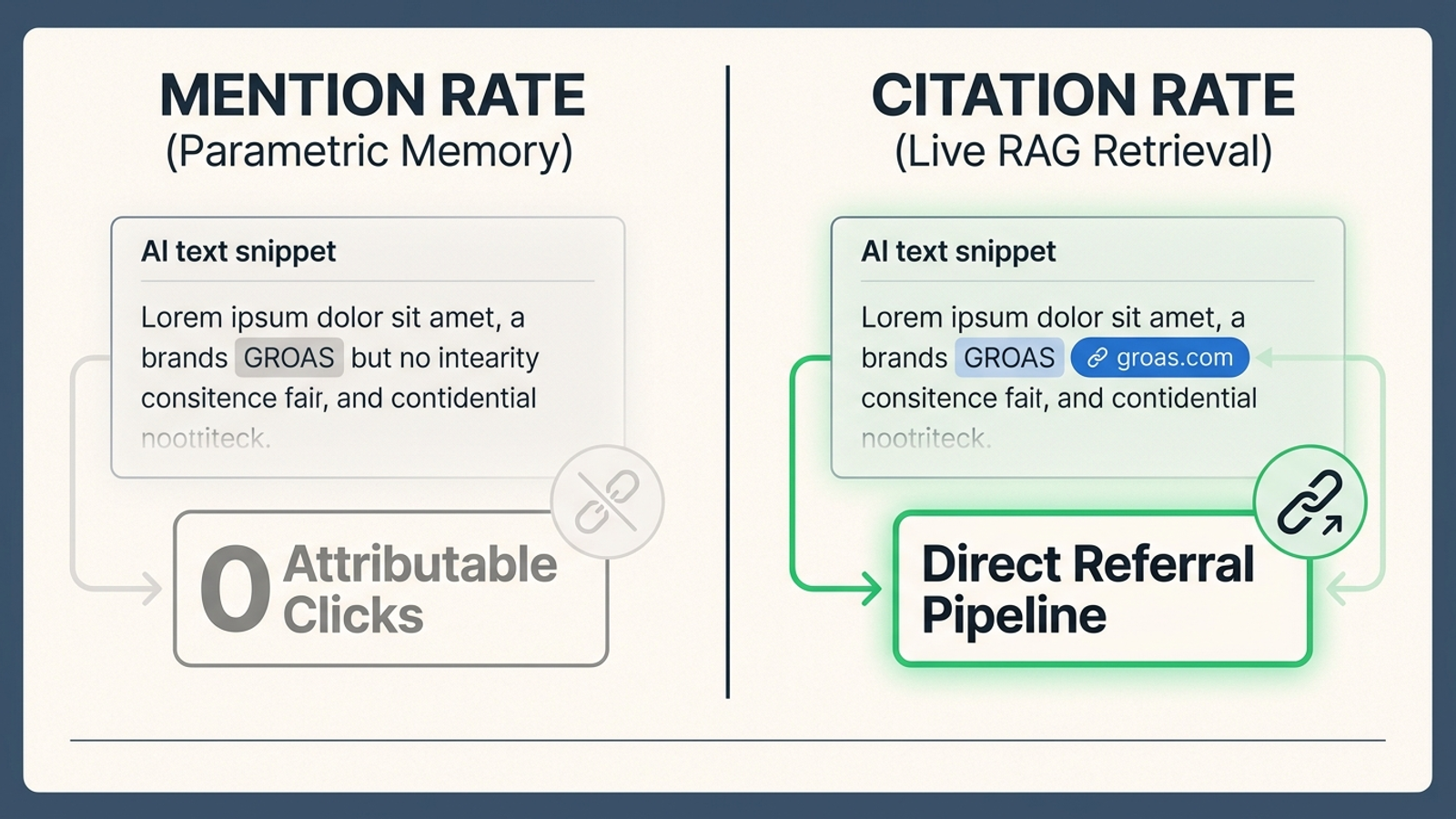
Definition: Citation rate counts explicit source links in generated answers; mention rate counts unlinked appearances of a brand name.
Practitioner gloss: These are not interchangeable. As the discussion of citation rate vs. mention rate explains, a mention can reflect what a model already associates with a brand, while a citation points to a source linked in an answer. An unlinked mention gives a buyer no direct path to the client’s page.
A blended chart can hide a 2% citation rate behind a 70% mention rate and call the campaign a success. Ask for both numbers separately, then ask whether either is contributing to attributable traffic or pipeline. A mention is worth knowing about. It is not a click with better typography.
Verified AI crawler traffic
Definition: Verified crawler traffic checks the source of bot requests rather than trusting the name in an HTTP User-Agent header.
Practitioner gloss: Any scraper can call itself GPTBot/1.0 or PerplexityBot. One analysis puts spoofed requests at 5.7% of traffic claiming AI User-Agents. Counting headers alone tells a client what bots claimed to visit, not which ones did.
Verification can use Forward-Confirmed Reverse DNS and autonomous system number checks against the relevant bot’s published identity. If crawler analytics cost extra, ask how the vendor verifies a request. Paying an add-on fee to count counterfeit visitors is a peculiar way to protect margin.
Synthetic AI visibility score
Definition: A synthetic AI visibility score compresses mentions, prompt rankings and engine appearances into a vendor-defined number, usually from 0 to 100.
Practitioner gloss: This is the term I would retire. It is AEO’s version of a reassuring dashboard badge: neat enough for a monthly slide, vague enough to survive a bad month for pipeline. Generative engines do not consult a vendor’s blended health score before answering a buyer’s question.
Put unlinked mentions, directory listings and hand-picked prompts into one formula and you can make the number rise without showing what changed for the business. Keep the underlying measures; retire the synthetic score. If the client asks whether search is producing qualified pipeline and revenue, a green 83 is not an answer.